
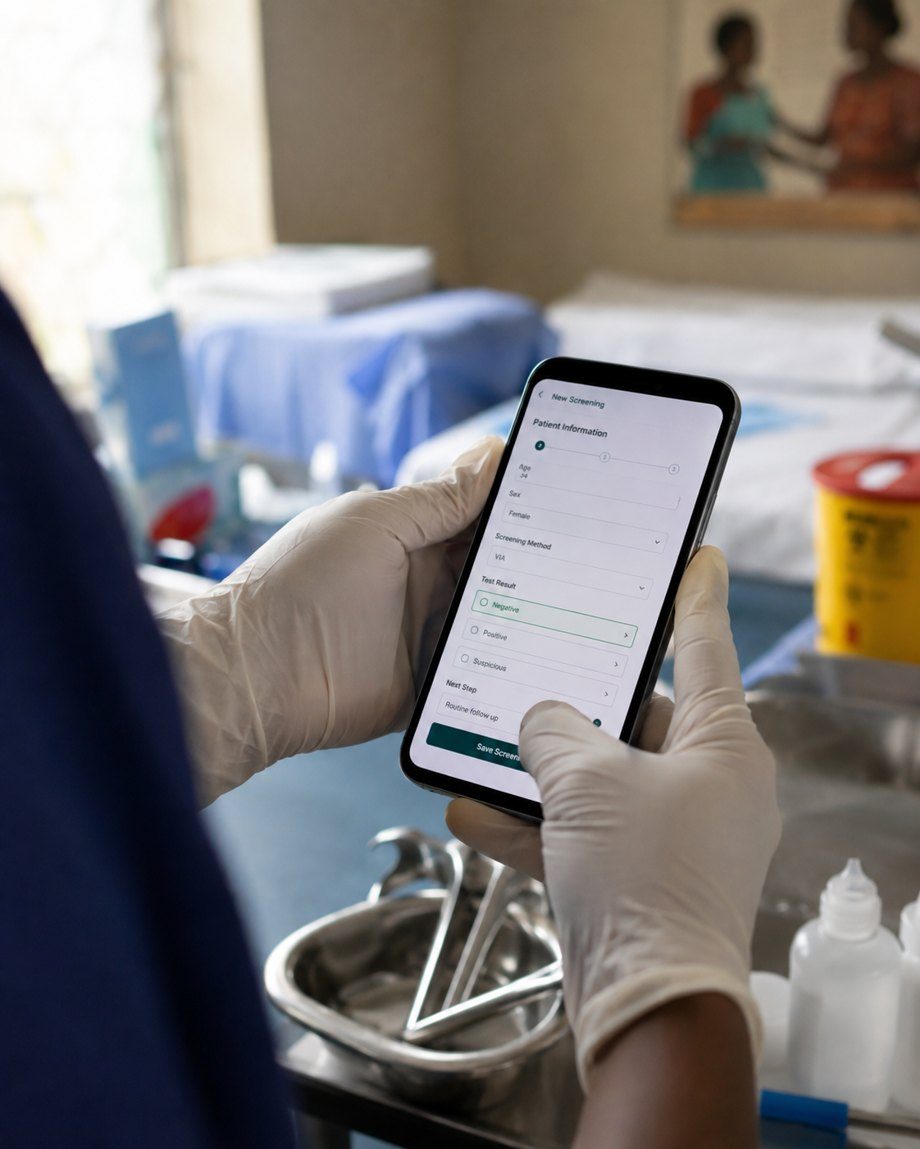
Visual inspection with acetic acid is not a complicated procedure. A provider applies dilute acetic acid to the cervix, waits, and looks for the characteristic whitening that can indicate precancerous change. It needs no laboratory, no cold chain and no pathologist. In settings where cytology and HPV testing are difficult to sustain, that simplicity is exactly the point.
And yet a screening programme built on it can still fail — not because the test is wrong, but because everything around the test is disconnected. That gap is the problem SEVIA was built to close.
The procedure was never the bottleneck
When we mapped what actually happens around a single screening encounter, the procedure occupied a few minutes in the middle of a much longer chain. Before it: identifying and reaching the woman, and having a trained provider present. After it: recording the finding, deciding on treatment, making a referral if needed, following up on whether that referral was completed, and rolling all of it up into something a programme manager can act on.
Almost every one of those steps was held together by paper, memory or a phone call. A provider might make a confident, correct assessment that never reached anyone who could act on it. A difficult case might be one that a more experienced colleague could have resolved in seconds — if there had been any way to show it to them.
The patient, provider, image, clinical decision, reviewer, referral pathway and programme team all need to remain connected. SEVIA creates the digital environment around that journey.
What the smartphone actually changed
The smartphone in SEVIA is not there to replace clinical judgement. It is there to make the encounter shareable. Once an image exists in a structured record attached to a patient, a provider and a decision, several previously impossible things become routine.
- A less experienced provider can get a second opinion without the patient travelling anywhere.
- Supervision can happen remotely and continuously, rather than during occasional supervisory visits.
- Programme managers can see screening volume, quality and referral completion as they happen.
- Training can be built from real cases from the same context, rather than textbook images.
The peer-reviewed evaluation of this approach in JCO Global Oncology described exactly this shift: a platform for secure cervical-image sharing, remote supportive supervision, and data monitoring and evaluation. The contribution was not a better test. It was a connected programme.

Implementation is where the evidence lives
A later implementation evaluation, published in the International Journal of Environmental Research and Public Health in 2024, looked at SEVIA across both urban and rural Tanzanian settings and documented the barriers and enablers reported by patients, providers and programme stakeholders.
That kind of study is easy to undervalue. It produces no new algorithm and no headline accuracy figure. What it produces is an account of why a system that works in principle does or does not work in a specific clinic, with specific staffing, specific connectivity and specific patient expectations. For anyone planning a deployment, that is the more actionable document.
The design position
Our conclusion from this programme has become a general rule for the health work we take on: if a digital health intervention only improves the moment of care, it will struggle to show programme-level impact. The value accumulates in the connections — between the encounter and the record, the record and the reviewer, the reviewer and the referral, the referral and the follow-up.
SEVIA supports clinical workflows and quality assurance. Interpretation and clinical decisions remain with qualified providers.