
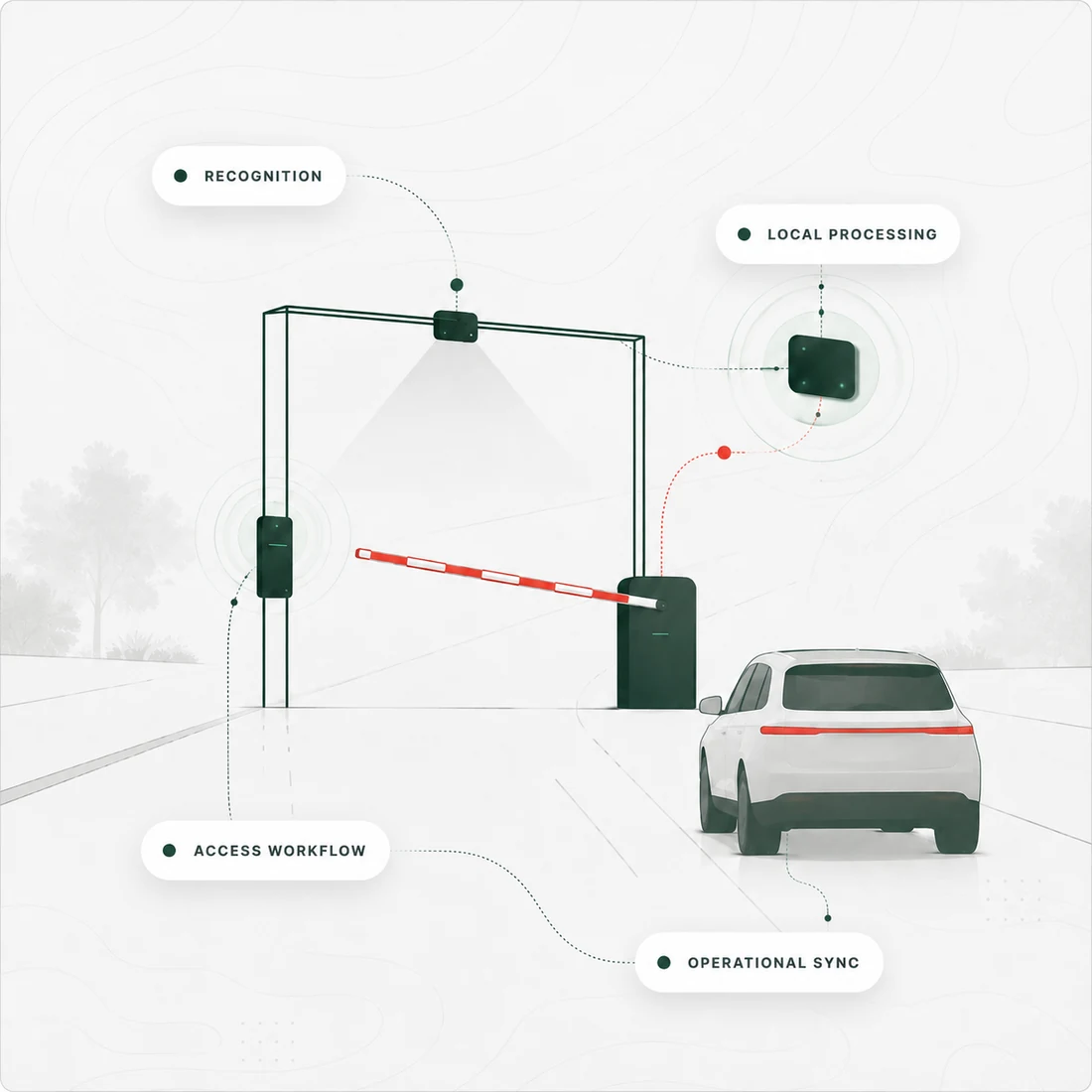
Software teams are used to thinking of an interface as something on a screen. In the NCAA digital transformation programme, the most important interface has no screen at all. It is a barrier, a camera and a vehicle arriving at a gate, often in poor light, often in a queue, always with a driver and passengers who would rather be moving.
Everything the institution wants — accurate permit records, reliable visitor counts, operational visibility across sites — is downstream of what happens in those few seconds.
The queue is the constraint
Any process added at a gate is multiplied by every vehicle passing through it, and paid for in queue length. A verification step that takes an extra twenty seconds does not cost twenty seconds; at volume it costs a queue that staff will find a way around, usually by skipping the step. A system that is routinely bypassed produces data that is worse than no data, because it looks complete.
So the design question is not "what would we like to capture here" but "what can be captured without making the gate slower than it was before".
- Automated vehicle identification removes a manual lookup from the critical path.
- Permit processing that happens before arrival turns verification into a check rather than a transaction.
- Passenger counting that is automatic avoids a headcount that nobody has time to do accurately.
- Edge processing keeps the decision local, so a slow link does not become a slow gate.
The programme brings together automated access systems, vehicle identification, permit processing, edge computing, passenger counting, surveillance and operational data across multiple sites.
Multiple sites, one picture
A single instrumented gate is a useful pilot and a poor programme. The institutional value appears when several sites report into one operational picture — when movement across the landscape, rather than activity at one entrance, becomes visible.
That is also where the engineering gets harder. Sites differ in power, connectivity, traffic profile and physical layout. The temptation is to build one rigid configuration and force every site to match it. What has worked better is a common data contract with site-specific implementations underneath: every gate must be able to answer the same questions, but how it answers them can vary with what it has.

Automation as a gradient
The programme is described as increasingly automated, and that phrasing is deliberate. Each step is earned by demonstrating that the automated path is at least as reliable as the manual one it replaces, in the conditions where it actually runs — at night, in dust, with a dirty plate, with an unusual vehicle.
Staff keep an override throughout. A system that cannot be overridden at a physical gate is not a safer system; it is one that will eventually strand somebody.